

Telecoms Q4 2025 report: $1bn investments fuel network gains, narrowed rural-urban video gap
…But 5G and rural divides endure

Nigeria’s telecommunications sector recorded tangible advancements in the fourth quarter of 2025 (Q4 2025), propelled by over $1 billion in industry investments that enabled the rollout of more than 2,850 new network sites nationwide.
These capital inflows expanded both coverage and capacity, contributing to measurable improvements in median download speeds, a strengthened 4G backbone, and a notably narrowed urban-rural gap in video Quality of Experience (QoE).
However, the Nigerian Communications Commission’s (NCC) “Connecting Nigeria: National Mobile Network Performance Report” for Q4/December 2025, powered by Ookla Advanced Analytics, also exposes enduring challenges.
One of the most prominent is the persistent 5G coverage and effectiveness gaps that leave roughly half of 5G-capable devices unable to connect, alongside a lingering rural-urban performance divide of up to 40 percent in key metrics like speeds and latency.
Released during a media engagement, the report provides a comprehensive, crowdsourced snapshot of real-world mobile network performance across urban centers, rural communities, major highways, and emerging 5G zones.
It underscores the dual narrative of progress and persistence. While investments are yielding everyday benefits, like faster browsing, smoother streaming, and more reliable connectivity, the full potential of next-generation technologies remains unrealized due to optimization hurdles, legacy network dependencies, and uneven infrastructure distribution.
Aminu Maida, the executive vice chairman of the NCC, highlighted this balanced view in his remarks on the report. “Today’s engagement reflects our commitment to transparent, data-driven regulation and the continuous improvement of Nigeria’s digital ecosystem. Through our collaboration with Ookla, we are providing independent insights into real-world network performance and the lived experience of Nigerians across cities, rural communities, highways, and emerging 5G zones,” he stated.
Maida pointed to clear gains, stating, “The data shows clear and steady improvements in network quality, particularly in median download speeds across both urban and rural areas, especially when compared to Q3 performance. Notably, the video Quality of Experience gap between urban and rural areas has narrowed, and the strength of our 4G backbone continues to improve.”
He directly linked these outcomes to 2025’s substantial investments, which resulted in the deployment of more than 2,850 new sites to expand both coverage and capacity nationwide.
Acknowledging shortcomings, the EVC stated, “The industry is not without challenges, as reflected in gaps in 5G services and inequalities in upload speeds highlighted in the reports.”
Maida noted ongoing regulatory engagements with operators and secured commitments to surpass 2025 investment levels in 2026, focusing on spectrum optimization, rural expansion, and quality-of-service enforcement.
Abraham Oshadami, the executive commissioner for technical services, NCC, opened the briefing by emphasizing transparency as a core regulatory principle.
“We believe that open access to information strengthens the industry, builds public trust, and reinforces accountability among operators,” he said.
He referenced the NCC-Ookla partnership that produced nationwide coverage maps and quarterly reports, starting from Q3 2025. “Our collective efforts are beginning to yield positive results. We are observing measurable improvements in network performance and, importantly, in the Quality of Experience delivered to consumers,” Oshadami noted.
Nnenna Ukoha, head of the public affairs department, welcomed media partners and advocated for constructive framing in coverage. “Presenting issues in a way that highlights progress alongside challenges, shows the solutions being deployed, reflects the investments and innovations shaping the sector. Your reporting shapes the national narrative around telecommunications. It affects investor confidence, consumer trust, and policy direction,” she urged.
The report’s metrics illustrate operator-specific strengths amid the broader trends. MTN maintains national leadership with average download speeds around 28.6 Mbps, stable urban latency (29 ms) and rural (38 ms), low jitter, and high scores in web browsing (65.9) and video streaming (63.98).
Airtel delivers balanced performance, particularly strong in uplink speeds (8.6 Mbps) for creator economies and remote work in southern and metropolitan areas.
T2 demonstrates localized rural excellence, achieving 24.9 Mbps rural downloads, outpacing MTN’s 15.8 Mbps, Airtel’s 10.6 Mbps, and Glo’s 9.5 Mbps, with peaks like 82.3 Mbps in Anambra and 80.0 Mbps in Oyo.
Glo ensures widespread baseline access with regional video strengths.
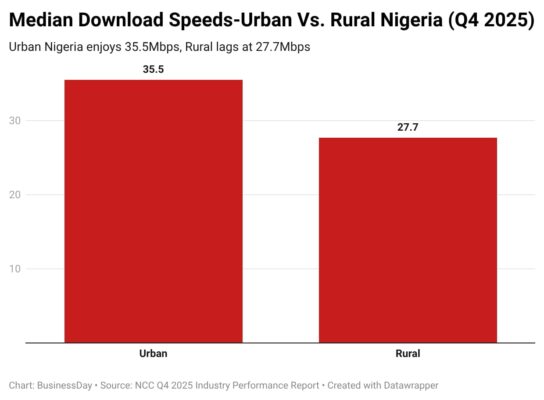
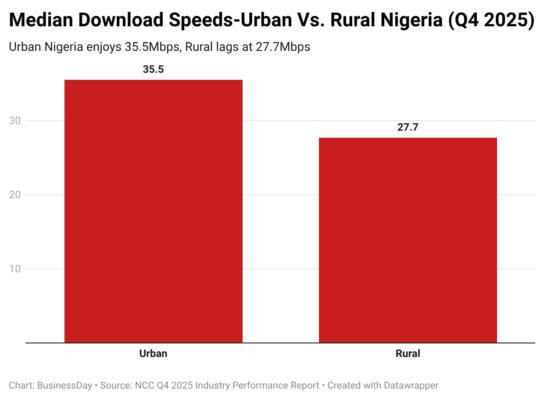
Urban areas lead with median download speeds of 35.52 Mbps compared to rural 27.67 Mbps (a roughly 22-40 percent gap depending on aggregates), yet the video QoE disparity has shrunk to just two percent (urban 65.7 vs. rural 64.39), enabling more equitable basic streaming nationwide.
Major highways spanning ~292,000 km boast near-universal coverage, with only 0.27 percent of primary routes showing total blackouts; T2 excels in consistency, and 4G provides reliable on-the-move performance (>97 percent compliance for GPS/streaming).
Challenges persist in underserved zones, where poor signal quality causes 40 percent slower speeds, elevated latency, buffering, and device stress, including battery drain and overheating during peak hours.
The 5G “reality check” is particularly stark. Effective coverage hovers at 27 percent in Lagos and 31 percent in Abuja, with average gaps of 55.4 percent and 47.4 percent respectively, meaning many 5G-capable devices fall back to 4G due to incomplete optimization, compatibility issues, or unactivated sites.
The report urges targeted actions. Consumers should upgrade to 4G/5G devices for dramatic experience gains (page loads dropping from 10+ seconds on legacy networks to 2-3 seconds); operators must optimize urban 5G deployments, densify rural infrastructure to close the 40 percent performance divide, enhance latency/jitter for gaming and video, and improve symmetrical uploads (currently lagging at ~11-12 Mbps) to support digital creators and remote work.
Regulators are encouraged to accelerate 2G/3G phase-out for spectrum reallocation and prioritize stability metrics over peak speeds.
Overall, the Q4 2025 data reflects a sector building momentum through sustained investment and regulatory oversight. The narrowed video QoE gap and highway reliability signal inclusive progress, yet the enduring 5G access barriers and rural-urban asymmetries highlight the work ahead.
As Nigeria advances toward broader digital inclusion, potentially leveraging satellite broadband for hard-to-reach areas, the success of future efforts will depend on translating capital into equitable, stable, high-quality connectivity for all citizens.