Senegal awards award-winning football team cash prizes and plots of land

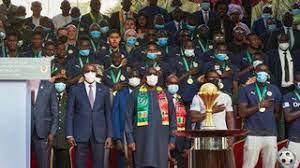
Senegal awards award-winning football team cash prizes and plots of land

Senegal’s President Macky Sall awarded the national football team cash prizes and plots of land on Tuesday, AFP reporters said, following the squad’s weekend victory in the African Cup of Nations.
In a ceremony in the presidential palace in the capital Dakar, he also appointed team members to the West African country’s prestigious Order of the Lion, as thousands of fans cheered outside the gates.
“By your vital force and your creative genius, you have reversed the course of history,” the president said, standing on a podium beside the Cup of Nations trophy.
“We dreamed of the cup, you built this dream and you made it come true,” he added.
Led by Liverpool star Sadio Mane, Senegal overcame Mohamed Salah’s Egypt 4-2 in a penalty shoot-out in Sunday’s final in Cameroon. The game had finished goalless after extra time.
The victory marked Senegal’s first success after over fifty years of fielding teams in the tournament — and sparked jubilant celebrations across Dakar on Sunday.
Hundreds of thousands of ecstatic fans also flooded the streets of the city of three million people on Monday — which the government had declared a public holiday — to greet the team as it returned from Cameroon.
Daily newsletterReceive essential international news every morning
Three people lost their lives during the massive celebrations, Sall said.
On Tuesday, he announced a prize of the equivalent of some $87,000 for each team member, as well as a 200 square-metre (2,100 square-foot) plot of land in Dakar, and a 500 square-metre (5,400 square-foot) plot in the nearby city of Diamniadio.
“There are no words to express you to our pride, our joy and our gratitude,” Sall said.
The president also urged Senegal coach Aliou Cisse to lead his team to the semi-finals of the 2022 World Cup, held in Qatar.
(AFP)