
PINL, NDLEA Launch Joint Drive to Tackle Rising Drug Abuse in Niger Delta

Pipeline Infrastructure Nigeria Limited (PINL) has announced a new partnership with the National Drug Law Enforcement Agency (NDLEA) aimed at curbing rising drug abuse among young people in the Niger Delta.
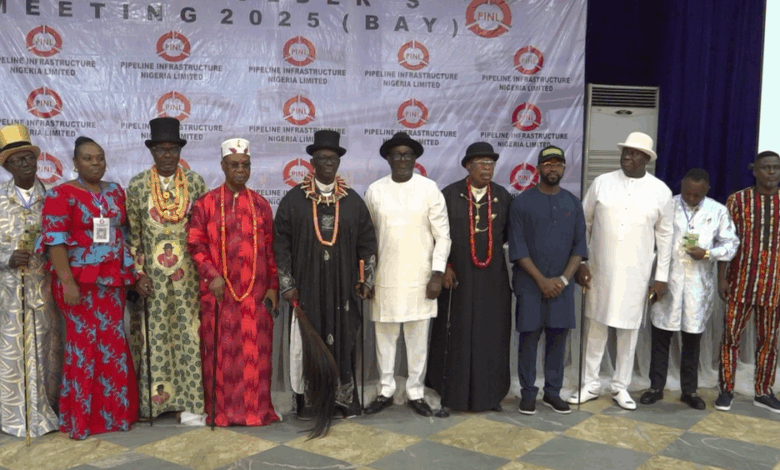
The company says the initiative follows appeals from community leaders concerned that substance abuse is fuelling insecurity, vandalism and declining productivity across the region’s Eastern Corridor. The plan was disclosed at PINL’s November stakeholders’ meeting with host communities along the Trans Niger Pipeline (TNP) in Bayelsa State.
Dr Akpos Mezeh, PINL’s General Manager for Community and Stakeholders Relations, said the awareness campaign would focus on drug abuse prevention, security ethics and responsible behaviour.
“We heard the appeal from our royal fathers regarding drug abuse and youth moral reorientation,” he said, adding that internal discussions had begun on rolling out the joint campaign with the NDLEA. He said the effort was designed to strengthen discipline, patriotism and responsible conduct among youths.
Boosting grassroots communication
Dr Mezeh also announced the deployment of town criers across 215 TNP host communities in Rivers, Bayelsa, Imo and Abia States. Each community now has two designated town criers—a man and a woman—tasked with sharing verified information, aiding sensitisation efforts and improving early-warning intelligence.
He said the move was part of recommendations from an earlier stakeholders’ meeting and was already improving communication between communities, contractors and the company.
Security gains and reduced vandalism
PINL reported what it described as significant progress in reducing pipeline vandalism. According to Mezeh, the company has maintained uninterrupted production in the Eastern Corridor, with Bayelsa State recording no vandalism incidents in October and November.
Attempts at pipeline vandalism, he said, have dropped by more than 87% compared with 2022. Community-based intelligence has also surged from 10.5% to 68%, a development he attributed to improved trust between communities, traditional leaders and surveillance teams.
He added that Biseni Clan had now been fully integrated into the company’s operations, while other communities had been submitted to the Nigerian National Petroleum Company Limited (NNPCL) and the Office of the National Security Adviser (ONSA) for approval.
Expanding community support
PINL also highlighted progress in its corporate social responsibility schemes. About 2,000 women under the company’s SME support initiative have completed registration and bank documentation and are expected to receive funds before year-end. Its scholarship programme, Mezeh said, is 97% complete, with disbursements also set to begin shortly.
Looking ahead, PINL reaffirmed its commitment to maintaining zero pipeline infractions, strengthening youth and women empowerment programmes, and pushing for improvements in critical infrastructure—especially roads that affect its field operations.
Community leaders react
Community leaders at the meeting praised the company’s efforts.
His Royal Highness Chief Theophilus Moses, Chairman of the Ijaw National Congress (Western Zone), commended PINL for job creation and community-focused programmes. He pledged the INC’s continued support in the fight against crude oil theft and pipeline vandalism.
The Chairman of the Bayelsa State Traditional Rulers Council, King Bubaraye Dakolo, urged government and oil firms to invest more deliberately in the region’s development. He argued that inadequate access to refined petroleum products in oil-producing communities remained a major driver of illegal activities.
Meanwhile, the Director General of the Bayelsa State Youth Development Centre, Comrade Robert Igali, encouraged young people to take advantage of PINL’s scholarships and empowerment programmes to improve their livelihoods.