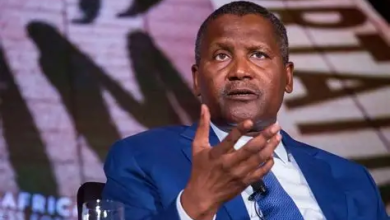

Otti pushes South East energy masterplan, says region can generate 15,000MW in 10 years

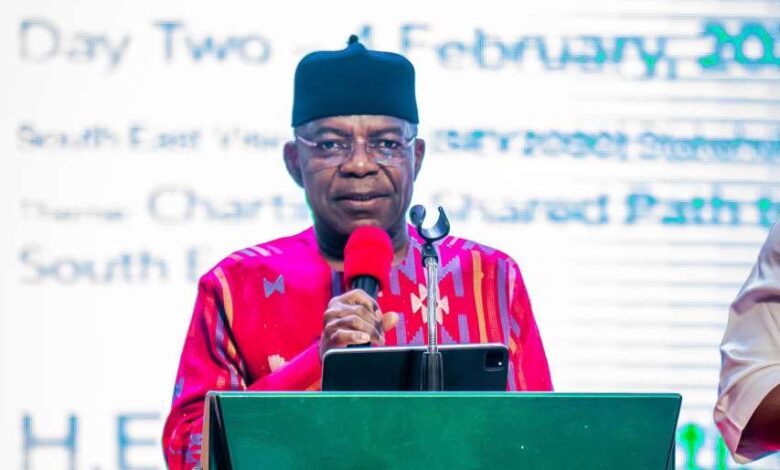
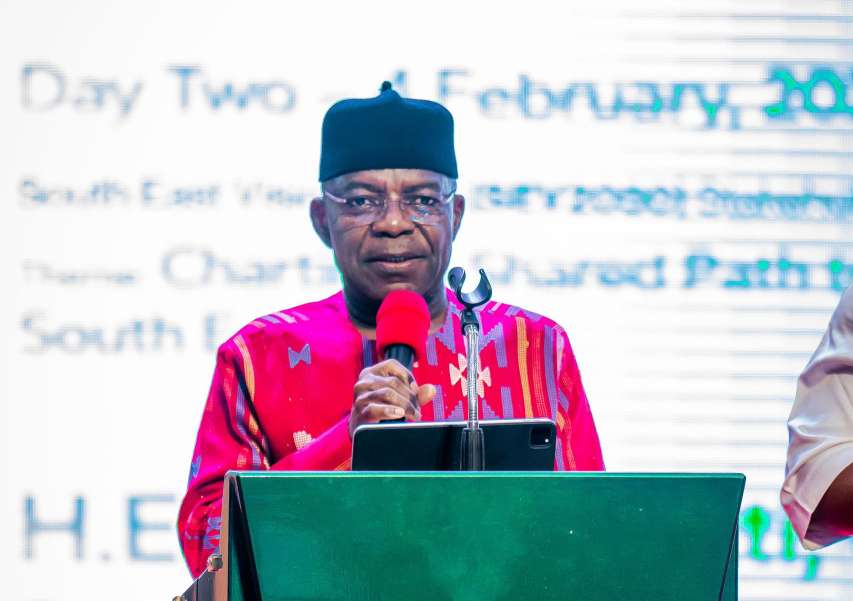
Governor Alex Otti of Abia State has made a strong case for a coordinated regional energy strategy as the foundation for industrialisation and long-term economic revival in Nigeria’s South East, declaring that the region possesses enough energy resources to generate between 10,000 and 15,000 megawatts of electricity within the next decade if properly harnessed.
Otti spoke on Wednesday at the South East Vision 2050 Regional Stakeholders’ Forum held at the International Conference Centre, Enugu, where he delivered an address titled “Powering industrialisation in the South East: the case for a regional energy strategy.”
The forum, convened under the auspices of the Office of the Vice President, the Federal Ministry of Regional Development and the South East Development Commission (SEDC), drew governors, policymakers, private sector leaders, development partners, and community representatives to chart a 50-year development trajectory for the region.
The Abia governor said the event had already succeeded in shifting conversations from “the glory of individual states and communities to the destiny of the collective,” stressing that the South East could no longer afford to operate in silos if it hoped to unlock its vast economic potential.
Energy as the bedrock of industrial growth
Otti argued that reliable electricity supply remains the single most important factor in reviving the region’s industrial heritage, particularly in cities such as Aba, long known as the manufacturing hub of the South East.
He cited the experience of Aba following the commissioning of the Geometric Power plant, describing it as practical proof that steady and predictable electricity supply directly translates into increased investments, resurgence of businesses, real estate growth, and job creation.
“Power is the foundation of industrial growth and the modern Aba is proof that investments and higher enterprise outputs are functions of steady and predictable power supply,” he said.
According to him, the resurgence of hundreds of previously moribund businesses in Aba over the past two and a half years was not merely the result of road rehabilitation or urban renewal, but primarily due to restored private sector confidence driven by improved governance and reliable power.
He noted that the Aba ring-fenced electricity zone is now largely insulated from disruptions on the national grid, offering a model that other parts of the region could emulate.
Electricity Act 2023 opens new possibilities
Otti commended the Federal Government for reforms in the power sector following the Nigerian Electricity Act of 2023, which liberalised the electricity market and enabled states and private entities to participate directly in electricity generation, transmission and distribution.
He said conversations about a regional energy strategy would not have been possible without the legal framework created by the Act.
In Abia, he disclosed, the state government had already moved to take advantage of the new regime by enacting a mini-grid regulatory framework, acquiring distribution assets previously owned by Interstate Electric, and establishing the Abia State Electricity Regulatory Authority (ASERA), which has now taken over regulatory responsibilities from the Nigerian Electricity Regulatory Commission (NERC).
“Effectively, the Abia State Government is functionally involved in every layer of the electricity value chain in the state, with a long-term view to creating a stable market that would eventually be driven by competent private sector players,” he said.
The governor proposed a three-legged framework for a South East regional energy strategy: resource identification and optimisation, sustained investment in energy infrastructure, and adoption of the right market model.
On resource identification, Otti said the region is richly endowed with multiple energy sources that remain largely untapped.
He listed vast natural gas reserves in Imo State, crude oil deposits in Abia, Imo and Anambra, significant coal deposits in Enugu and Ebonyi, as well as strong potential for solar, hydropower and biomass energy across the region. He also highlighted untapped gas reserves in Ukwa West Local Government Area of Abia, near the Abia Industrial Innovation Park.
“These resources are enough to drive a comprehensive energy plan for industrial-scale output, but potential and reality are often worlds apart without deliberate planning,” he said.
He called for the development of a comprehensive regional energy resource dossier to serve as the foundation for long-term policy and investment decisions.
Coal still relevant for development
Addressing concerns about the global energy transition, Otti argued that coal should not be dismissed as a viable energy source for the region, given its abundance in Enugu and Ebonyi.
He noted that major industrial nations, including China, the United States, India and Japan, still rely significantly on coal for electricity generation, and questioned the fairness of expecting the South East to abandon its resources while struggling with energy poverty.
“Africa’s share of global emissions is less than five per cent. It would be unfair for us to remain in darkness when the resources that can power our industries lie beneath our feet,” he said.
While acknowledging the need for renewable energy adoption, he maintained that no energy option should be taken off the table in the push for industrial energy sufficiency.
Investment, pricing and end to estimated billing
Otti stressed that transforming the region’s energy landscape would require massive and sustained investments in infrastructure spanning power plants, transmission lines, substations, transformers and metering systems.
He advocated a model where governments initially de-risk investments and later divest to allow private investors run the system efficiently under strong regulatory oversight.
He also emphasised the importance of fair and realistic electricity pricing, balancing investors’ need for returns with consumers’ limited purchasing power.
The governor was particularly critical of estimated billing, describing it as exploitative and inconsistent with fair business practices. He called for compulsory metering funded by service providers to ensure transparency and accountability.
Call for regional collaboration
In his concluding remarks, Otti urged South East states to embrace collaboration rather than competition in developing a regional energy masterplan.
He suggested that instead of building entirely new plants that could take decades, existing facilities like Geometric Power could be expanded with additional turbines and power wheeled across state boundaries.
“We are better together. There are multiple opportunities for cooperation and resource sharing if we get serious with a regional energy masterplan,” he said.
Otti maintained that breaking the cycle of poor electricity supply is central not only to industrialisation but also to improvements in education, healthcare, security and overall quality of life in the region.
He expressed confidence that with strategic leadership, sincere collaboration and long-term commitment, the South East could free itself from the limitations of poverty, unemployment and economic desperation by building an energy system that is enterprise-focused, service-driven and resilient.