


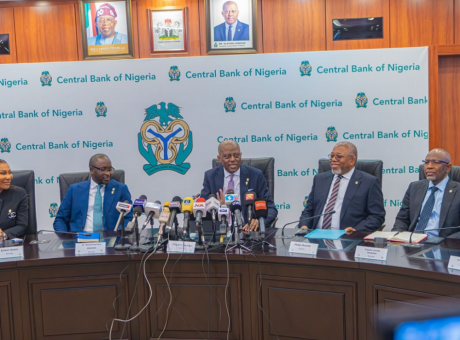
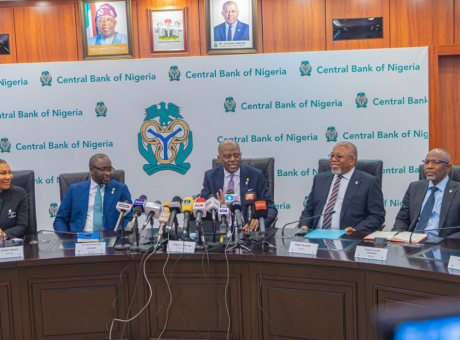
The Central Bank of Nigeria (CBN) yesterday announced a major cut in the nation’s underlying interest rate benchmark, reducing the Monetary Policy Rate (MPR) by 350 basis points from 26.50 per cent to 23.00 per cent.
The apex bank said the decision was taken to make monetary policy framework more effective and in line with the country’s stable macroeconomic fundamentals.
At the end of its 307th policy meeting yesterday in Abuja, the 11-member Monetary Policy Committee (MPC) of the CBN voted to reduce the MPR by 350 basis points, adjust the Standing Facilities Corridor around the MPR from +50 and -450 basis points to +50 and -300 basis points. It voted to hold other parameters unchanged.
The committee retained the Cash Reserve Requirement (CRR) at 45 per cent for deposit money banks, 16 per cent for merchant banks and 75 per cent for non-Treasury Single Account (TSA) public-sector deposits. Liquidity ratio remained unchanged at 30.0 per cent.
The MPC, headed by CBN Governor Olayemi Cardosos, is the highest policy-making organ of the apex bank. The MPC traditionally provides monetary policies and benchmarks, which determine the direction of the financial services sector, and the economy to a large extent.
The MPR serves as the anchor rate for interest rates in the economy. It is the baseline rate for transactions by the central bank and other banks, and thus serves as the benchmark upon which banks build their interest rates for loans. The MPR is a central tool for controlling money supply, inflation and general economic direction. By adjusting the corridors- the upper and lower boundaries, around the MPR, the apex bank is providing sufficient support for financial system stability while encouraging bank lending.
Speaking after the meeting yesterday in Abuja, Cardoso, said the decision was taken at a time when the country’s economic fundamentals had improved sufficiently to allow the bank to make the adjustment.
He said the CBN had moved from a period of significant economic volatility to one in which businesses and investors could make plans with greater certainty.
“Fundamentals have changed. We are at macroeconomic stability, from a situation of great volatility to one where the market is stable. We can plan. We can project,” Cardoso said.
He explained that the apex bank’s objective was to ensure that the MPR again becomes the main signal for monetary policy and that changes in the benchmark rate are transmitted more effectively through the financial system.
According to him, the adjustment should not be interpreted as a change in the underlying monetary policy stance, but rather as “an operational realignment of the monetary policy framework to strengthen transmission and support Nigeria’s transition towards an inflation-targeting system”.
He noted that the adjustment was necessary because the relationship between the MPR and prevailing market interest rates had weakened.
According to him, the apex bank wants to close the gap between its benchmark rate and the rates at which banks lend and borrow in the money market.
“We have the firm belief that it is not working as effectively as it should,” Cardoso said, referring to the transmission of monetary policy.
He added: “Our MPR and the interbank rates, there’s a gap between the two. And quite frankly…there’s a need to close that gap.”
The Nigerian equities market responded positively to the apex bank’s adjustment, rallying N298 billion in capital gains as investors raised expectations on lower borrowing costs and improved earnings for listed companies.
The All-Share Index (ASI)- which tracks share prices of all quoted companies at the Nigerian Exchange (NGX), rose by 18 basis points to 250,614.66 points. Aggregate market capitalisation of quoted equities rose by N298 billion to close at N162.683 trillion.
Experts described the interest rate cut as significant reset for the economy, commending the apex bank for the transition of the country’s macroeconomic stability into greater support for the productive sector and consumers.
Chief Executive Officer, Centre for the Promotion of Private Enterprise (CPPE), Dr Muda Yusuf, said the MPC decision was a significant and positive turning point in the monetary policy cycle.
“The 350-basis-point adjustment should help reduce financing pressures on businesses, strengthen investment prospects, support economic growth and progressively moderate the government’s domestic debt-service burden,” Yusuf said.
Professor Uche Uwaleke of Nasarawa State University said the MPC decision was justified by moderating inflation, exchange rate stability, improvement in foreign exchange market liquidity, and accretion to external reserves.
“It is a welcome development against the backdrop of the recently signed memorandum of understanding (MoU) between the Minister of Finance and the CBN Governor on fiscal and monetary policies collaboration,” Uwaleke said.
Analysts at Coronation Asset Management described the decision as “a decisive policy pivot”, while Arthur Steven Asset Management said it was a significant shift towards a less restrictive monetary policy stance.
“The rate cut has important implications across asset classes. We expect declining yields to increase the case for selective duration extension in fixed income, while lower financing costs could support corporate earnings, particularly across the manufacturing and consumer goods sectors. For banks, the impact is likely to be mixed as lower asset yields could pressure margins, although stronger credit growth and effective repricing could provide an offset,” Arthur Steven Asset Management stated.
Cordros Capital Group said they expected market performance to be shaped by the extent to which the policy adjustment translates into lower market yields, improved liquidity and reduced corporate financing costs.
“Continued macroeconomic stability, particularly in inflation and the exchange rate, will also remain important to investor sentiment. Against this backdrop, 2026 full-year earnings and dividend announcements, foreign and domestic portfolio flows, corporate actions and company-specific developments are likely to be the key drivers of the market performance in fourth quarter 2026,” Cordros Capital stated.
The MPC’s decision came against the backdrop of further moderation in inflation and stronger economic activity.
Headline inflation fell marginally to 15.39 per cent in August from 15.43 per cent in July. Food inflation had declined from 20.31 per cent to 19.57 per cent, while core inflation dropped from 14.97 per cent to 13.29 per cent.
On a month-on-month basis, headline inflation slowed considerably from 1.57 per cent in July to 0.71 per cent in August. The 12-month moving average of headline inflation also declined to 16.30 per cent from 16.89 per cent.
The MPC said the continued fall in inflation reflected the impact of previous monetary policy tightening, greater exchange-rate stability and improved inflation expectations.
The committee noted that headline inflation had declined for three consecutive months, despite continuing geopolitical tensions in the Middle East and higher global energy prices.
Cardoso said the CBN believes the disinflation process is continuing and that the recent policy adjustment should not be taken as a signal that the bank is abandoning its restrictive approach.
“We will stay on the course which has been a restrictive one for as long as we have,” Cardoso said.
The MPC also pointed to stronger economic growth as another factor supporting its decision. Nigeria’s real Gross Domestic Product (GDP) expanded by 4.43 per cent in the second quarter of 2026, up from 3.89 per cent in the first quarter.
The non-oil sector grew by 4.31 per cent from 3.94 per cent in the previous quarter, supported by activities in information and communication technology, crop production, real estate, livestock, financial services and trade.
The oil sector also recorded a sharp improvement, growing by 7.31 per cent compared with 2.57 per cent in the first quarter. The improvement was attributed to higher oil production and increased investment in the sector.
The Composite Purchasing Managers’ Index, another measure of business activity, rose to 52.7 points in August from 51.1 points in July, indicating continued expansion.
The country’s external position also strengthened during the period under review. Gross foreign exchange (forex) reserves stood at $55.25 billion as of September 18, 2026-the highest level in 18 years. The forex reserves could finance about 11.3 months of imports of goods and services.
Nigeria’s balance of payments surplus increased to $3.51 billion in the second quarter from $2.38 billion in the first quarter, while the current account surplus rose by 67.92 per cent to $7.54 billion from $4.49 billion.
Cardoso linked the stronger external position partly to improved forex conditions and increased diaspora remittances.
He pointed out that CBN’s efforts to attract remittances had produced significant results, noting that monthly inflows had risen substantially from the levels recorded when the initiative began.
He noted that the apex bank had targeted $1 billion in monthly remittances and was approaching that level by July.
He added that the CBN would continue engaging Nigerians living abroad and promoting formal channels for sending money into the country.
Cardoso, who is marking his third year at the helms of the apex bank, pointed to the reform of the forex market as one of the major changes made during his three years as Governor.
He highlighted that the previous system of multiple exchange-rate windows created distortions and allowed different groups of market participants to access foreign exchange at different rates.
According to him, CBN’s move towards a more transparent willing-buyer, willing-seller system has helped close the gap between exchange rates and reduce the distortions associated with the former arrangement.
He said: “When you go and do a survey of who was able to get those rates at that lower rate, you’ll find that that’s a handful of individuals. What has happened is that we have succeeded in closing that gap, unifying the exchange rates”.
Cardoso also used the occasion to point to what he described as major changes in the CBN’s approach since he assumed office three years ago.
He said the bank inherited a situation in which Ways and Means financing had risen to N23.7 trillion, alongside more than N10 trillion in interventions.
He linked the large injections of liquidity into the economy with the inflationary pressures that followed.
“Our responsibility was to restore stability and maintain both price and financial stability,” Cardoso said.
He also identified the recapitalisation of the banking industry as another major development during his tenure.
He said the recapitalisation programme had strengthened banks’ capital buffers and resilience and improved their ability to finance long-term projects in important areas of the economy.
Cardoso said the recapitalisation announcement had initially been met with skepticism, but later developments demonstrated the need for stronger capital positions in the banking industry.
CBN’s latest decision comes as Nigeria prepares for an election period that could bring additional liquidity into the economy.
Cardoso said the bank had carried out scenario analysis to assess possible changes in currency circulation, banking-system liquidity, monetary aggregates and foreign exchange demand during the period.
“We will not base things on assumptions, we will carefully monitor currency in circulation, banking system liquidity, monetary aggregates, foreign exchange demand, and act accordingly,” Cardoso said, assuring on the readiness of the apex bank to maintain monetary stability.
According to him, the CBN would proactively use its monetary tools to mop up excess liquidity if necessary.
He said: “We are going to be proactive. We will not allow ourselves to be caught unawares in any form”.
Cardoso also said the CBN would work with law-enforcement agencies to prevent currency abuse and would continue to encourage electronic payments because they provide a transaction trail.
The MPC’s position on election-related risks comes as the bank also begins a new phase of cooperation with the Federal Government on fiscal and monetary policy.
Cardoso said the recently signed MoU between the Ministry of Finance and the CBN would formalise cooperation that had existed between the two sides for years.
“There’s nothing new about this. It’s always been a source of coordination between the fiscal and the monetary,” Cardoso said.
He however highlighted that the major difference was that the relationship had now been institutionalised.
“I think the difference here is that we’ve decided to institutionalise this,” Cardoso said.
He said this was important because individual officials eventually leave office, while formal arrangements can preserve coordination between institutions.
Cardoso also linked the agreement to Nigeria’s planned transition towards inflation targeting.
According to him, inflation targeting cannot be successfully achieved by monetary policy alone because fiscal decisions also affect liquidity, demand and prices.
“Having such an MOU signed is going to make it significantly different and significantly easier for us on that road of inflation targeting,” Cardoso said.
The MPC also welcomed the Federal Government’s National Affordable CNG Transit Programme, saying lower transportation costs could help reduce inflationary pressure.
Despite the improvement in domestic indicators, the committee warned that risks remained. It said global growth was projected at three per cent in 2026, down from 3.5 per cent in 2025, due partly to the conflict in the Middle East, continuing trade-policy uncertainty and limited fiscal space.
Global inflation risks also remain tilted upwards because of supply-chain disruptions, high crude oil and commodity prices and increasing fragmentation of global trade. For Nigeria, the MPC identified prolonged geopolitical tensions and election-related spending as possible sources of renewed price pressure.
The committee, however, expects domestic output to remain resilient through the rest of the year, supported by improved crude oil production, stronger agricultural activity and continued expansion in other business sectors.
It also expects inflation to moderate further in the short to medium term, supported by relative stability in the foreign exchange market, the delayed effects of earlier monetary tightening and increased food supplies during the harvest season.
The CBN said it would continue to monitor the effectiveness of the new interest-rate corridor and make future decisions based on economic data.
For Cardoso, the latest adjustment represents part of a broader effort to make the monetary policy framework more effective as economic conditions improve.
“This is a reset and a recalibration. That is all it is,” Cardoso said.
Yusuf said the MPC decision was particularly positive for the real sector, where high financing costs have become a major constraint on investment, production, working capital and job creation.
He said: “For many businesses, commercial lending rates have remained at levels that are difficult to reconcile with productive investment, particularly in manufacturing, agriculture, construction, logistics and other sectors with relatively long investment cycles and tight margins.
“The policy adjustment therefore offers an opportunity to reduce the cost of capital, improve business cash flows, stimulate investment and strengthen the productive capacity of the economy”.
He however noted that the ultimate economic value of the decision would depend on transmission, calling on banks to reflect the new monetary policy environment in the pricing of credit.
“Lending rates on both new and existing facilities should progressively adjust downwards. Without meaningful transmission to borrowers, the impact of the policy adjustment on investment and economic growth would be limited,” Yusuf said.
He added that the decision also has potentially significant positive implications for public finance as the high interest-rate environment had contributed materially to the escalation of the Federal Government’s domestic debt-service burden.
He noted that government securities have had to compete with exceptionally high market yields, increasing the cost of borrowing and placing additional pressure on already constrained fiscal space.
“A sustained moderation in interest rates should reduce the marginal cost of government borrowing and, over time, moderate domestic debt-service costs. This could create additional fiscal space for infrastructure, security, education, healthcare and other development priorities. The fiscal dividend would, however, depend on the extent to which the MPR adjustment translates into lower yields across the government securities market,” Yusuf said.