Kano 2027: Political Realignments, Defections Set Stage For Fierce Contest

Kano State holds the record of having the largest number of voters in the country. Because of this, every political party is usually interested in controlling the state. LONGTONG YAKUBU writes that the 2027 elections will not be an exception, given the numerous defections that have characterised the politics of the state in the last few weeks.
As political activities gradually gather momentum ahead of the 2027 general elections, Kano State is once again emerging as a theatre of intense intrigue, shifting alliances and strategic defections that are redefining its political landscape. What initially appeared as internal party disagreements has since snowballed into a broad realignment of forces, with key actors abandoning old platforms and forging new coalitions in a bid to secure relevance and electoral advantage.
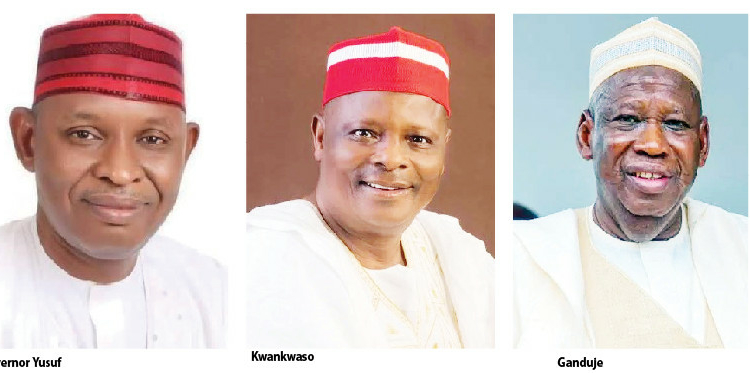
The current administration in the state came to power in 2023 under the New Nigeria Peoples Party (NNPP), with Governor Abba Kabir Yusuf riding on the influence of the Kwankwasiyya movement led by former governor Rabiu Musa Kwankwaso. The victory was widely seen as a resurgence of Kwankwaso’s political structure and a disruption of the All Progressives Congress (APC) ‘s dominance in the state.
However, the political equation has since witnessed a dramatic shift. Governor Yusuf’s defection to the APC on January 26, 2026, marked a major turning point, as he justified the move on the need to align with the centre for effective governance and development.
The decision triggered a chain reaction, with 22 members of the Kano State House of Assembly defecting alongside him, effectively weakening the NNPP’s legislative base and strengthening the APC’s dominance in the Assembly. The development also extended to the national level, where eight members of the House of Representatives from Kano defected from the NNPP to the APC.
While the APC appeared to be consolidating power, a counter-alignment emerged with the defection of Rabiu Musa Kwankwaso to the African Democratic Congress (ADC). His move drew several loyalists, including former deputy governor Abdulsalam Gwarzo and the 2023 APC governorship candidate, Nasiru Gawuna, both of whom pitched their tents with the ADC.
The unfolding developments have also revealed cracks within the state executive council, as some commissioners have resigned in alignment with the Kwankwasiyya movement, further underscoring the depth of the political realignments.
Providing insight into the evolving scenario, a Kano-based political analyst, Kabiru Sufi, said the recent wave of defections clearly signals the early commencement of 2027 political activities.
“With the recent happenings within Kano politics, one can say that activities towards the 2027 election have started in earnest,” he said.
Sufi observed that the situation has taken an unusual dimension, noting that key actors from the last election have effectively switched camps.
“What we are seeing is that the two heavyweights of Kano politics have swapped sides. The sitting governor has moved to the APC, while the former APC governorship candidate is now with Kwankwaso in the ADC. This makes the scenario very interesting,” he added.
According to him, the emerging alliances have fundamentally altered the political equation in the state, creating two formidable blocs heading into the next election cycle.
“Now you have Ganduje and Governor Yusuf on one side, strengthened by incumbency, while Kwankwaso, with his popularity, is on the other side with Gawuna and even the former deputy governor. This has changed the entire scenario of the game,” he explained.
The analyst further noted that the developments point to a highly competitive contest, rather than a one-sided race as earlier speculated.
“I think it is an indication that there is going to be a sharp contest this time around,” he said.
He stressed that Kwankwaso’s role in the upcoming elections would be a major factor, particularly if he appears on the ballot.
“If Kwankwaso appears on the ballot, whether as a presidential or senatorial candidate, it will boost the chances of the ADC and make the contest even more competitive,” Sufi stated.
On the likely battlegrounds, he noted that while traditional voting patterns may still hold in some areas, others could prove decisive.
“For now, Kano North appears to remain a stronghold of the APC, while Kano Central may tilt towards the ADC. However, Kano South will be the swinging factor, as both parties will scramble to gain control of that zone,” he said.
Despite the unfolding political drama, Sufi cautioned against making early predictions, noting that several variables would determine the eventual outcome. “It is still too early to call. A lot of factors will come into play, including how the parties manage their internal dynamics and the kind of candidates they present,” he added.
For the APC, the challenge will be managing internal cohesion amid the influx of new entrants, while the ADC will need to consolidate its structure and convert its growing support base into electoral strength.
As the permutations continue to unfold, Kano’s political landscape remains fluid, reflecting the broader dynamics of Nigeria’s evolving democracy. With defections, alliances and counter-alliances shaping the terrain, the stage appears set for what could be one of the most keenly contested elections in the state’s history.