

On the streets of Nigeria’s capital, a new chapter is being written. Not by the hawkers who weave through traffic selling bottled water and gala, nor by the beggars who tap relentlessly at tinted windows at every intersection but by a government determined to reclaim the city’s dignity, street by street.
At the heart of this push is Barrister Nyesom Wike, the Minister of the Federal Capital Territory (FCT), a man famed for his iron will and no-nonsense approach to urban order. This time, his mission is clear: Abuja will no longer be Nigeria’s “beggars’ capital.”
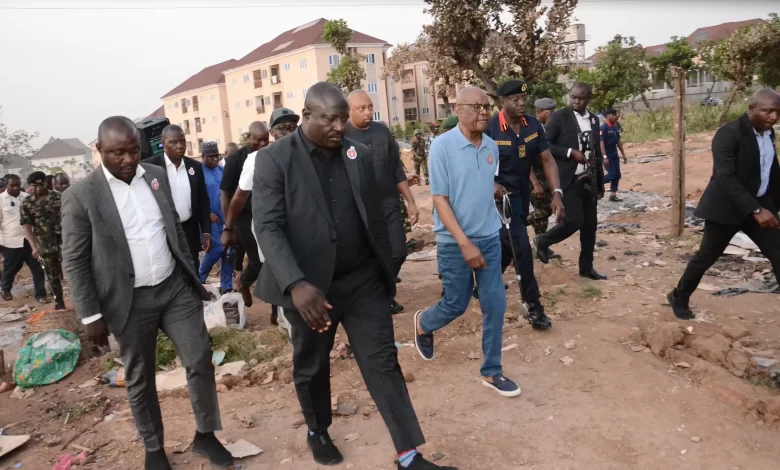
“We Have Declared War” It began with a vow that cut through the hum of construction noise at the flag-off of an access road to the Judges’ Quarters in Katampe. Flanked by dignitaries and security chiefs, Wike didn’t mince words.
“Abuja is turning into a beggars’ city,” he declared. “If you know you have a brother or sister begging here, tell them to leave now. From next week, we will take them out. We have declared war.”
To the Minister, street begging is not charity, it is a mask for crime and exploitation. For years, syndicates have preyed on Nigeria’s poorest, trafficking children from far-flung villages and dumping them at Abuja’s intersections, from Gwarimpa to Asokoro. Some beggars, authorities believe, double as informants for pickpockets and ‘one chance’ robbers.
“It is embarrassing,” Wike said, “that people come into our capital and the first thing they see is beggars lined up at every junction. Some are criminals. Some pretend to be sick. We will not allow it.”
True to his word, the operation began before the dust from his speech had settled. By Monday, police trucks and paramilitary convoys rolled out across the city in what has become known as Operation Sweep Abuja Clean.
Leading the charge is former Commissioner of Police Olatunji Disu, backed by teams from the Department of State Service (DSS), Nigeria Security and Civil Defence Corps (NSCDC), the Military Police, the Abuja Environmental Protection Board (AEPB) and other agencies. Their brief? Simple: comb every corner.
“For the first two weeks, we will search every black spot, every bridge, every hideout,” Disu told his men at dawn.
Four days later, the figures shocked even seasoned officials: 210 beggars in custody, 58 women, 72 children, and 80 men. The scene at the FCT Vocational and Rehabilitation Centre in Kuchikon, Bwari Area Council, where the apprehended were bussed in, was a stark illustration of a decades-old problem laid bare.
At the FCT Vocational and Rehabilitation Centre in Kuchikon, Bwari, the consequences of decades of neglect and poverty are on full display. Buses arrive daily, offloading men and women in rags, babies clinging to tired mothers, wide-eyed children who can’t name the villages they came from.
“What we discovered is even worse than we thought,” said Gloria Onwuka, Acting Director of the Social Welfare Department, as she watched new arrivals being processed.
“Many of the children were hired out by parents in rural villages. Some women fake illness. Some syndicates collect the money at the end of the day. This is organized exploitation.”
One child, about 9, told a volunteer that he was from Kano but could not say exactly which village. “A man brings us in a bus,” he whispered. “He says if we don’t get plenty of money, we won’t eat.”
“Most of the children were hired,” Onwuka revealed. “We discovered some families actually rent out their kids. Syndicates drive into villages, pay parents a few thousand naira, bring the children into Abuja at dawn, drop them off at roundabouts to beg. By night, they vanish again.”
She recalls a particular woman who claimed she had breast cancer and needed money for surgery. “When our female officers untied the bandage nothing. Not even a scratch.”
Residents have long whispered about the links between street begging and petty crime. The beggar tapping your window today might point you out to a pickpocket tomorrow.
“These people exploit the city’s compassion,” said Adamu Gwary, Director of FCT Security Services, “We believe many are tied to petty theft, ‘one chance,’ and other crimes.”
Gwary, represented by Dr. Peter Olumuji, Secretary of the FCT Command and Control Centre said at the Kuchikon centre, didn’t mince words either. “This is why the Minister gave a clear directive: this city must be safe. This time, it will not just be talk.”
But the crackdown is not without its critics. At Berger Junction, one of the city’s busiest, residents have mixed feelings.
“I’ve been robbed twice by boys who pretend to beg,” said Mrs. Elizabeth Ikenna, a civil servant. “I fully support the Minister. This nonsense must stop.”
But Usman Sule, a cab driver, sees another side. “Some are criminals, yes. But some are just hungry. If you arrest them, where do they go?”
It is this fine line between compassion and law enforcement that will test whether Wike’s big bet pays off.
Unlike past raids that simply loaded people onto buses and dumped them at state borders, the FCT says this time it’s different.
Dr. Sani Rabe, Director of Social Welfare, insists the plan includes rehabilitation and reintegration.
“Those willing to learn will get vocational training here,” he explained. “We will trace their families if possible. Some will be returned to their states. But it’s complicated. Many don’t want to go home, some have no families left.”
The FCTA is also liaising with states to ensure repatriated beggars don’t find their way back on new buses.
Street begging is only one piece of Wike’s war on urban disorder. Illegal roadside mechanics, scavengers pushing carts through estates, unpainted taxis all are in the crosshairs.
“We cannot call ourselves the seat of government and look like a slum,” said Kaka Bello, Head of Enforcement at AEPB, as he oversaw the removal of makeshift mechanic sheds beneath the Garki flyover.
“This is the capital of Africa’s largest democracy. It must look like one.”
As the street sweep gathered steam, another front opened. Over 280 vehicles, cars, tricycles, commercial motorcycles have been seized for traffic violations, unregistered plates, or aiding criminals.
“Taxis operating without colours or number plates are being pulled off the roads,” said Dr. Olumuji. “These cars are often used for ‘one chance’ robberies. We’re shutting that down too.”
The FCT’s traffic agencies, VIO, and the police have made it clear: no documentation, no vehicle.
Residents say they are already seeing results. Black spots like Gwarinpa Bridge and the ever-busy Wuse Market are noticeably emptier.
“Abuja is becoming too hot for criminals,” Olumuji said. “That’s exactly what the Minister wants: a city where law-abiding people feel safe and criminals have nowhere to hide.”
Of course, Abuja has tried this before. Sweeps under past ministers cleared the streets for a while. But the problem always crawled back: poverty, conflict in the hinterlands, and corruption in the system.
“This time we must get it right,” Wike has told his team. “We must sustain it, rehabilitate the genuine cases, and prosecute the syndicates. That is the only way.”
‘Operation Sweep Abuja Clean’ may be just a few weeks old, but its message is loud: Nigeria’s seat of power will not surrender its dignity to street syndicates, petty criminals, or urban decay.
Whether this latest offensive becomes a footnote in the city’s cycle of crackdowns or the beginning of real change will depend on what comes next: jobs for the desperate, support for the vulnerable, and the political will to stay the course.
For now, the trucks keep rolling. The checkpoints remain. And the message from the top echoes through every raid: Abuja will no longer be the beggars’ capital not on Wike’s watch.