

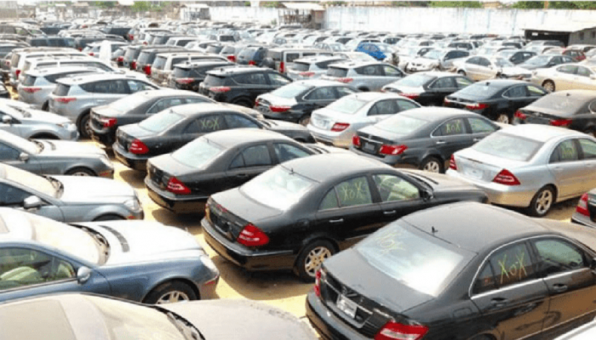
The National Assembly has declared that Nigeria can no longer continue to serve as a dumping ground for foreign used vehicles, pledging to accelerate the passage of the proposed National Automotive Industry Bill 2026 to protect local manufacturers and promote the production of vehicles in the country.
Chairman of the Senate Committee on Industry, Senator Francis Fadahunsi, made the declaration when members of the committee, alongside the National Automotive Design and Development Council (NADDC), inspected the facilities of PAN Nigeria Limited yesterday in Kaduna.
Fadahunsi, who is a retired Customs officer, said his experience had exposed the enormous resources Nigeria was losing through the continued importation of foreign used vehicles, which he said had contributed to the depletion of the country’s foreign exchange reserves.
“Nigeria has become a dumping ground. So we have to reject it,” Fadahunsi said.
He said the Federal Government must begin to encourage Nigerians to patronise locally manufactured vehicles, stressing that Nigerian engineers had demonstrated the capacity to produce vehicles and other means of transportation capable of meeting the needs of the country.
According to him, the committee, during its inspection, saw locally produced tricycles and vehicles that had been tested and found to be stronger and more suitable for Nigerian conditions than some imported alternatives.
“Today, the Federal Government will be aware that there are better alternatives that Nigerian engineers can do, can produce, to ameliorate all these imported vehicles, imported tricycles that are being used by the rural population,” Fadahunsi said.
He said the PAN facility represented a major national industrial asset that could significantly contribute to employment, economic growth and affordable transportation if fully supported by the government.
He said the facility, which occupies almost 300,000 square metres, still had functional production and training facilities and could employ more than 3,000 people if operating at full capacity.
Fadahunsi also disclosed that PAN’s training facilities had produced about 12,000 artisans across the country, including roadside mechanics, forklift operators and other technicians, describing the development as an important contribution to the economy.
He appealed to President Bola Ahmed Tinubu to strengthen support for the automotive industry, saying greater patronage of locally manufactured vehicles would reduce the pressure on Nigeria’s foreign exchange reserves and create employment opportunities.
He said: “Mr. President, you should know the gravity of this, the drain on our foreign reserve caused by this particular product”.
Fadahunsi further pledged the National Assembly’s support for the proposed National Automotive Industry Bill 2026, saying its passage would provide the legislative framework needed to protect local investments and discourage indiscriminate importation of vehicles.
Managing Director, PAN Nigeria Limited, Mrs Taiwo Oluleye, had appealed to the National Assembly to urgently legislate the bill, saying the automotive industry required stronger policy protection to survive and attract fresh investments.
Oluleye said PAN, established in 1972 and which commenced operations in 1975, had an installed annual capacity of 90,000 vehicles, but production had declined due to high operating costs, exchange rate challenges, high borrowing costs and policy contradictions.
She said the company had evolved from a single-brand assembly plant into a multi-brand automotive facility producing SUVs, sedans, buses and pick-ups, with some buses converted into ambulances.
According to her, PAN had previously achieved 40 per cent local content in its production when the industry enjoyed an enabling policy environment, whereas local content in the industry had now fallen below four per cent.
She said the proposed legislation would protect investments in existing assembly plants and address the imbalance between manufacturers who invest heavily in local production and businesses that simply import completely built vehicles.
“We appeal to you by this visit that you review and legislate. The legislation of this policy will protect investment and develop local production as opposed to importation of vehicles,” Oluleye said.
She warned that without adequate protection, investors in local vehicle assembly would continue to face unfair competition from importers, making it difficult for Nigeria to develop a sustainable automotive manufacturing industry.
Oluleye described the automotive industry as “a gold mine”, noting that it had strong linkages with the steel, aluminium, plastics, rubber, finance, ICT, logistics, engineering and research sectors.
She said the sector could serve as a major platform for Nigeria’s industrialisation, while the proposed legislation would enable the country to take advantage of opportunities under the African Continental Free Trade Area.
Oluleye said Nigeria could become a major vehicle exporter to other African countries if it achieved the required local content and created an enabling environment for manufacturers.
Also speaking, the Director-General of NADDC, Oluwemimo Joseph Osanipin, said the inspection had demonstrated that Nigeria had the capacity to meet a substantial part of its domestic vehicle demand through local assembly.
“What we have seen here is evidence that we have the capacity,” Osanipin said.
He said PAN’s 90,000-unit annual installed capacity, combined with facilities in other parts of the country, particularly Lagos, could provide sufficient capacity to meet Nigeria’s local demand if fully activated.
The NADDC boss said the Council was already working to address the major impediments confronting the automotive industry, including legislation, patronage and access to credit.