
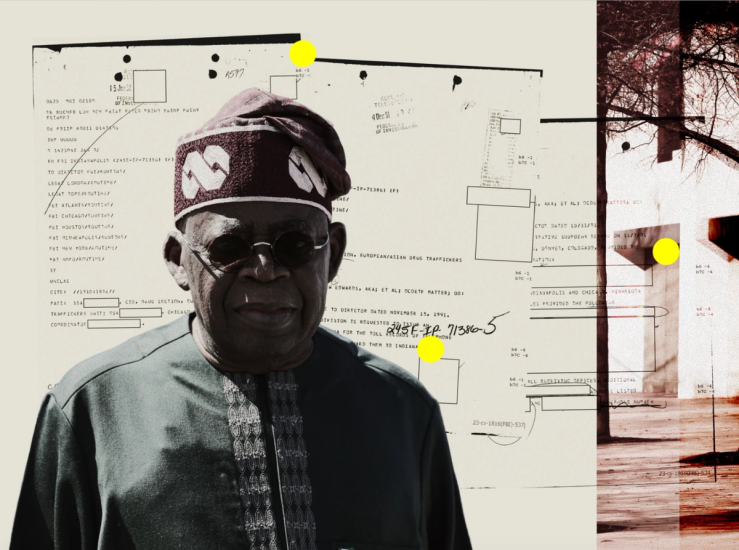
Nigeria’s president is locked in a fierce reelection battle — one that is not just playing out among voters ahead of January polls, but pitting teams of lawyers and lobbyists against a lone litigant half a world away in California. Remarkably, this latter-day David just won a significant victory over Goliath.
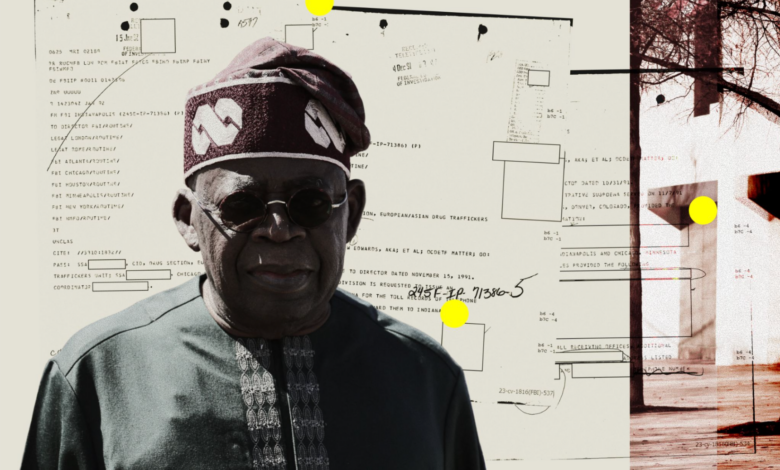
For three years, Bola Tinubu has fought to keep old FBI records tied to a 1990s Chicago drug probe about him sealed, hiring US lawyers to support the Justice Department in the fight. His main adversary is not a political rival or a diaspora activist, however. It’s a Freedom of Information Act litigant in California with no apparent connection to Nigeria who says he just wants to get to the truth.
Tinubu’s efforts to prevent disclosure have partly failed. In August, the FBI acknowledged for the first time that it holds an investigative file on him and alongside the Drug Enforcement Administration (DEA) has released hundreds of pages of partially redacted records.
The fight now underway is over whether that is enough. On one side is Tinubu’s team of US attorneys, led by Chicago firm Henderson Parks. On the other is Aaron Greenspan, founder of legal document website PlainSite, who argues more documents should be released, with fewer redactions.
The FBI declined to comment on this story. The DEA did not respond to requests for comment.
The case centers around an alleged heroin trafficking network run from Nigeria: A 1993 affidavit drafted by an Internal Revenue Service agent describes the scheme, and cites an associate of the narcotics-selling group as saying the network’s ringleader — allegedly Mueez Adegboyega Akande, a businessman who had returned to Nigeria in 1990 — directed its finances by phone and periodic US trips — and that Tinubu helped move money for him. In the 1990s, Nigerian rings often trafficked drugs from Southeast Asia to Chicago via couriers, according to the Justice Department.
The Nigerian president has repeatedly denied wrongdoing. And his links to the case have been known and partially reported within Nigeria, often in the run-up to elections where opponents have used it to raise questions about his past. But the latest release — though unlikely to materially affect the results of the upcoming election — once again concentrates attention on Tinubu’s time in the US.
A young Tinubu first arrived in Chicago in the 1970s to study accounting, graduating in 1979. By the time of the alleged scheme at the center of this case, he split time between Lagos and the US, having risen to treasurer at Mobil Oil Nigeria, and eventually winning a seat in Nigeria’s Senate — all while still opening bank accounts, and moving “large” amounts of money in the Chicago metro area, according to the IRS affidavit. Bank records cited show Tinubu went on to deposit nearly $1.9 million in Chicago-area accounts in 1990 and 1991. Tinubu’s then-employers at Mobil Oil told investigators his treasurer role did not involve moving large sums and that the company never authorized him to hold its funds personally.
US authorities said that several of the transactions were linked to the alleged drug-trafficking ringleader Akande and seized roughly $460,000 from accounts tied to Tinubu in a 1993 civil forfeiture, alleging that the money was likely the laundered proceeds of drug dealing. Tinubu was not criminally charged, and the case was dismissed with prejudice after the money was forfeited.
Tinubu’s US lawyers have argued that the latest files that Greenspan wants released are shielded by FOIA exemptions that protect against “an unwarranted invasion of personal privacy.” In a filing, the lawyers said that curiosity about a foreign leader’s background was not a FOIA-protected interest, and described Greenspan’s requests as driven by Nigerian politics rather than by an effort to expose US agency misconduct.
They also said the records concern Tinubu’s life as a private “student” who “should retain his full privacy interests because he was not a public official in 1993.” However, Tinubu was not a student in 1993 — he had graduated over a decade earlier — and he was, in fact, a public official for most of that year, serving in Nigeria’s Senate until November. Greenspan protested the inaccuracies in subsequent filings, and Tinubu’s team later recanted the claims.
In a statement to Semafor, Henderson Parks attorney Christopher Carmichael argued that commentary on the case had outpaced the facts: “Interested persons and parties are attempting to infer what they believe may be in undisclosed records, but that is speculation.” He said Tinubu’s team would not speculate on non-public records while the FOIA case was pending.
Tinubu’s aides have long presented the 1993 case as a closed civil matter. In a July statement, presidential spokesman Bayo Onanuga called it “a civil forfeiture case from 1993 — a matter long settled, with no criminal conviction or finding of guilt,” and added that the issue had been “thoroughly litigated, explained, and rendered moot” by Tinubu’s electoral victories.
Representing himself, Greenspan said in an interview with Semafor that he had no personal or national stake in Nigerian politics and had kept his distance from partisans on both sides. He is not new to protracted fights with well-resourced opponents: A Los Angeles-area tech entrepreneur, Greenspan has spent years trading lawsuits with Elon Musk and Tesla, often alone and against larger legal teams. When a lobbyist for former Nigerian Vice President Atiku Abubakar — an electoral opponent of Tinubu — filed an amicus brief, Greenspan sought to make clear that the two were not working together.
The case has been a political flashpoint in Nigeria for years, flaring up ahead of the 2023 election that brought Tinubu to office and again now with the 2027 vote fast approaching. An organization retained by the Nigerian government has targeted Greenspan online. Another of Tinubu’s main opponents called it “profoundly embarrassing” that Tinubu was asking a foreign court to withhold his records.
Nonetheless, there are doubts about whether the matter is viewed as important by voters. Much like Tinubu’s presidential tenure, the campaign has been dominated by conversations around economic tumult and insecurity. “It is unlikely to impact [voters’] decision,” said Ebenezer Obadare, an analyst with the Council on Foreign Relations in Washington, “though the situation might change if a highly damaging piece of information unavailable previously were to suddenly turn up.”